
Bosses Go Crazy
Published on 2nd July, 2026
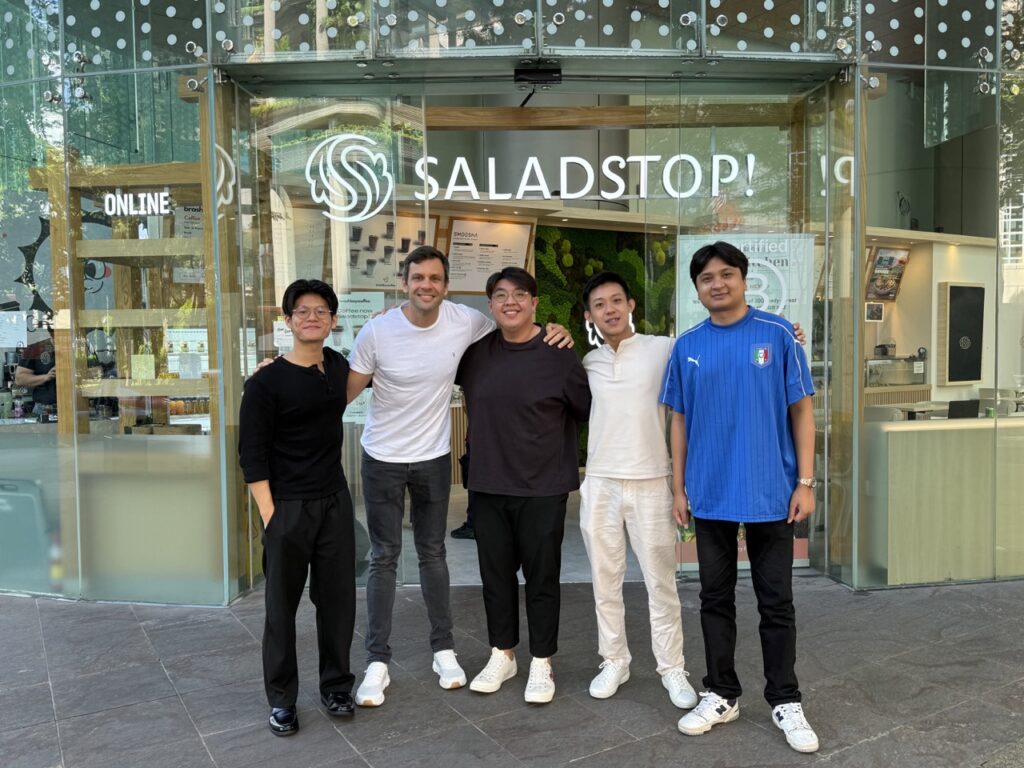

Over more a decade ago, Adrien saw an opportunity to bring in a salad QSR concept from the US into Singapore, but it wasn’t without challenges.
“A lot of people said Singaporeans are not going to eat salads & people compared our price point to a hawker centre”.
Singapore has been home to Adrien for 30 years, but prior to that, he was studying in the US and then moved to Shanghai, China for a job opportunity to which he lost it to the financial crisis. After moving back home, he saw an opportunity to bring in a healthier option food concept into Singapore which was nascent at that point in time.
His father, Daniel Desbaillets who has worked in the hotel industry and was looking for something new in his career decided to pour his retirement savings into starting what’s known as SaladStop! today with a staggering 75+ outlets worldwide.
Enjoying this story?
Get raw interviews and unfiltered lessons from entrepreneurs across Asia — straight to your inbox 👇
1. In the early days, they knew they had to speak to Singaporeans
Back in the US, Adrien saw the evolution of quick-service restaurants (QSR) in brands from Chipotle to Shake Shack as well as other brands who had been in the healthy food space for 2 to 3 years coming out of New York.
He saw a clear demand in a mature market like the US and saw how the concept would easily fit into CBDs in countries like Hong Kong and Singapore. It was also a time when there was more expats coming into Singapore, people were increasingly health conscious, and seeking healthier food options.
In Singapore specifically, he saw a missing product — salad — a blue ocean market.
“We had to do a lot of education around the product. People often challenged us on whether we could scale beyond five stores and whether the market was ready. We knew we needed to speak to Singaporeans, so we developed a Singapore chili crab dressing and tried to localise as much as possible while staying true to the product.”
The lesson is this: ideas and concepts that are mature in international markets may not yet exist in your current market. You have to have the ability to spot these opportunities. But while you may be the first person to bring a new product or concept into your country, you also have to spend time educating consumers, and this comes at a cost in terms of both capital and time.
2. Growth only happens outside of Singapore
Singapore is undeniably a great place to test new ideas and build a brand with incredible systems and forward-thinking technology, but it is a small and competive market where cost structures keep rising.
And real growth is only going to come from expansion outside.
“The biggest change (in the Singapore’s F&B scene) is the higher cost structures and compressing margins. We used to have a lot more leeway. Today it’s a very high-pressure environment, where choosing one wrong location can sink the whole ship. We benefit from economies of scale and a good understanding of the market, but for new entrants it’s incredibly hard.”
And not withstanding that in recent years the increasingly number of foreign brands entering Singapore.
To stay competitive, he said he has to be extra careful in selecting new locations, continously innovating around new products and technology as they have a captive audience who’s at the forefront of health which gives him a lot of feedback and to do A/B testing.
Today, SaladStop! is focused on expanding into the Middle East and Australia.
When asked, he said Middle East is a region with huge opportunities where they do not see huge competition where they could apply the same QSR model and a trend towards healthy eating (just like Singapore in its early days).
In Australia, while more mature, he sees a very scalable QSR model for the next generation where brands like Guzman Y Gomez are doing extremely well in.
The lesson is this: The Singapore F&B market has changed drastically over the years where cost structure keeps rising and competition has made it increasingly hard for not just existing players but even harder for new entrants. Making a wrong decision like choosing an incorrect location could be a bottomless pit.
So then, how do you win in today’s F&B market?
It brings us to the next point 👇
3. To succeed in today’s F&B, be super clear on your product niche
If you have plans to start an F&B brand one day, taking the lessons from Adrien and various other founders I’ve met, one common denominator is this: have a clear product niche that you understand deeply.
Rather than, “Oh, I love eating or drinking xxx and I’m going to create a brand out of it.”
He further shared that going into a category that’s already well established, heavy on capital expenditure, or manpower-intensive is going to be hard to scale in such a difficult market. Something more in tune with the next generation makes sense, because you can understand that customer base and build towards it.
4. Are schools built for entrepreneurship? His answer may surprise you
Honestly, Adrien’s answer to this question surprised me.
“It’s [education] more of a lifelong journey. I could have graduated early, but I stayed because I loved learning. That’s my biggest advice: take it all in.”
He said one should avoid jumping in too early without any frameworks or life experiences. He started the company when he was 29 years old and had a good understanding of running businesses and reading financial statements.
“You still need some baseline. But the world is very different now — you can build businesses today in a very different way. If you want to build a company on the side while studying, do it — it’s such a great time to have that freedom and flexibility. Now is the time to rethink business models and challenge the status quo.”
Here’s my personal take on the topic, hoping it can provide a little perspective to the younger generation:
My time in university wasn’t a waste. In fact, I think I made full use of my time in university to figure out what I was interested in and good at, and what I wasn’t.
Unlike most other students, knowing full well I couldn’t score well in school, I took the opposite path and focused on discovering my interests instead.
I took on 5 different internship roles in finance.
Did overseas volunteering in the Philippines.
Embarked on a life-changing 6-month overseas internship in Guangzhou, China, working for a startup incubator, and delayed my graduation for that.
And various others.
It was only when my perspective of the world enlarged that the possibilities of what I thought I could do enlarged too. And suddenly, things that I thought were scary weren’t that scary anymore.
If you got something out of this, the best thing you can do is share it with one founder or operator who’d appreciate it — that’s how this grows.
Bosses Go Crazy is where I share the real, unfiltered stories from the founders building across Asia.
Also read:
- He Quit a $15k-a-Month Job To Sell Nasi Lemak, and How He Nearly Lost It All 🤯
- “Terror or Euphoria” – Building a Company With Zenyum’s Founder 🦷
- The Duck Rice Stall That Went Public 🐥
Follow us on: Instagram | TikTok | Telegram Channel